What Should a Coach Focus on to Get More Clients? A Simple Priority Framework

One of the most frustrating questions in the messy middle of building a coaching business is:
What should I focus on right now if I want more clients?
Because there is certainly no shortage of options…am I right?
You could create more content, start a podcast, build a new freebie, rewrite your website, pitch yourself as a guest speaker, launch a new offer, learn Pinterest, finally figure out SEO, or make peace with Reels. Again.
And when all of those things could help your business, every task starts to feel equally important.
It isn’t.
Here’s the short answer: A coach should focus 1st on the earliest place where right-fit people stop moving toward becoming clients.
The absolute first place to start is to make sure you have a simple, clear, and specific offer that solves a specific problem. If you don’t have a paid way for ideal clients to work with you, then honestly, what’s the point of anything else?
If that’s where you’re stuck, check out Make Money Now where I show you step by step how to create and launch your first easy yes offer.
Once you have your clear offer, then it’s looking at these potential roadblocks:
If not enough of the right people are finding you, focus on visibility.
If they find you but don’t understand what you do, focus on messaging.
If they understand but don’t trust you yet, focus on nurturing.
If they trust you but don’t know how to work with you, focus on invitations.
If they show interest but disappear, focus on follow-up.
Your priority is not whatever another coach is excited about this week. It is the first significant problem preventing interested people from moving forward.
That is the heart of the Find Your First “No” Framework.
Why Do Coaches Struggle to Know What to Focus On?
Most messy-middle coaches are struggling because their time is spread across too many disconnected activities, and they don’t know which ones are actually helping create clients.
A typical week might include:
Writing 3 social posts
Tweaking an offer…for the 5th time
Watching a training
Updating a website page
Researching podcast equipment
Creating a new Canva template
Answering emails
Reorganizing approximately 37 Google Docs
But how much time was spent creating new client opportunities, nurturing interested people, making offers, or following up?
When you aren’t clear about what is creating clients and revenue, it’s easy to choose work that feels productive, familiar, or safe. Then August rolls around and you start hoping a fresh fall schedule will somehow make everything click.
But September won’t fix what August avoids.
Before you create another fall plan, you need to know which part of your current client-getting process needs your attention.
If you’re getting some clients but still can’t predict where the next one will come from, read [Why Am I Not Getting Coaching Clients Consistently? 7 Things to Check Before You Start Over].
The Find Your First “No” Framework
Answer the following 5 questions in order. Do not skip ahead to the question with the strategy you happen to like best.
The first question you answer with a clear “no” or “not consistently” reveals your current priority.
1. Are Enough Right-Fit People Finding You?
Even the most fantastic offer won’t create consistent sales if not enough of the right people know it exists.
Ask yourself:
Am I regularly getting in front of people who could become clients?
Are new right-fit people joining my email list or starting conversations with me?
Am I consistently using at least one strategy that introduces me to new audiences, such as podcast guesting, workshops, or guest teaching?
Are the people engaging with me potential clients, or mostly other coaches and service providers?
If the answer is no, your priority is getting in front of more right-fit people.
That doesn’t automatically mean posting more. Social media can support your business, but it shouldn’t carry your entire client-getting strategy on its tired little back.
One of the most effective ways to expand your reach is through borrowed trust: getting introduced to an established audience by someone they already know and trust.
Here’s what that could look like:
Be a podcast guest where your ideal clients already listen. A menopause coach might pitch podcasts for women over 40 about sleep, energy, weight, or midlife health. A brain-health coach could look for shows about healthy aging, caregiving, or dementia prevention. PodMatch, MatchMaker.fm, and PodcastGuests.com can help you find active shows looking for guests.
Teach inside someone else’s community. A menopause coach could offer a training inside a pelvic-floor therapist’s membership, women’s professional group, or dietitian’s community. A stress coach might teach inside a leadership program or employee-wellness group.
Connect with professionals who serve the same audience differently. Think therapists, dietitians, personal trainers, physical therapists, doulas, or HR consultants. Learn what they do, explain who you help, and explore ways to introduce each other to right-fit clients.
Pick one strategy and repeat it long enough to learn from it. Trying podcasts on Monday, Pinterest on Wednesday, and panic-posting on Friday may create plenty of activity, but it won’t give you enough evidence to know what’s actually working.
And important side note: Coaches notoriously spend WAY more time creating than they ever do promoting…when promoting and building their audience should be the #1 focus, always.
2. Do Right-Fit People Immediately Understand How You Help?
Perhaps people are finding you, but they aren’t inquiring, joining your list, or responding to your offers.
Your next question is whether they can quickly understand:
Who you specifically help
What problem you help solve
What result you help create
Why that result matters now
If not, your priority is messaging clarity.
More visibility won’t fix confusing messaging. It simply gives more people the opportunity to be confused.
Focus on using the language your ideal clients actually use, connecting your work to a specific problem they want solved, and making the value of your offer easier to understand.
Important side note: Most coaches spend too much time focused on program features like how long their program is or how many calls they should offer, when instead the focus is on what specific problem am I solving for my specific ideal client? People invest in solving problems, not nice-to-haves.
Also your message does not need to capture every wonderful, nuanced thing your coaching can accomplish. It needs to help the right person recognize herself and think, “Ohhh. This is exactly what I need.”
And if you’re creating genuinely useful content but it still isn’t leading to inquiries or clients, read [Why Your Coaching Content Isn’t Getting You Clients (Even When It’s Good)]. The answer may have less to do with creating more content and more to do with what happens after someone finds it.
3. Do People Have Enough Reason to Trust You?
People may understand what you do and still not feel ready to hire you.
They may need to experience more of your thinking, personality, process, and expertise before making a decision.
If people find you but rarely move closer, your priority may be trust-building and nurture.
That could include:
Sending useful, perspective-driven emails consistently
Sharing client examples, case studies, and testimonials
Teaching through workshops or guest trainings
Addressing the questions and hesitation potential clients have before buying
Showing how you think about their problem differently
Your audience can get generic information from Google or ChattyG before their coffee finishes brewing.
What they cannot get anywhere else is your perspective, lived experience, judgment, process, and ability to help them apply it.
4. Are You Clearly and Consistently Inviting People to Work With You?
Some coaches have an audience that understands and trusts them, but their offer remains one of the best-kept secrets on the internet.
They nurture, educate, and provide enormous value. Then they mention their paid offer in one tiny P.S. every 6 weeks and wonder why sales feel random.
If interested people don’t know exactly how you can help them next, your priority is making clear invitations.
An invitation should explain who the offer is for, what specific problem it helps solve, what result the client is working toward, and exactly what to do next.
You do not need to turn every email into a sales pitch. But people should not need 3 browser tabs, a magnifying glass, and Nancy Drew’s detective skills to figure out how to hire you.
Important side note: This has come up several times with my private coaching clients, they give a workshop (or even send an email) and there’s 2-3 calls to action. For example, they mention 2 offers during their workshop. Or at the end of their email, they say follow me on social, join my Skool community, grab my freebie…that’s too much! ONE program, 1 call to action/next step.
Track how many clear offers or invitations you make each week. You may discover that your sales problem is partly an invitation problem.
For more help making that next step clear and clickable, read[7 Call to Action Tips to Boost Clicks and Get More Coaching Clients].
5. Are You Following Up With People Who Show Interest?
If people are asking questions, attending your events, booking consultations, replying in the comments, DMing you, or saying “maybe later,” you already have potential client opportunities.
The question is: What happens next?
If you usually wait for them to return when they’re ready, your priority is follow-up.
Following up can be as simple as:
You mentioned wanting support with this after the summer, so I wanted to check in. Is this still something you’d like help with?
That isn’t pressure. It gives someone an easy opportunity to say yes, no, or not right now.
Create 1 place to track warm leads, previous clients, referrals, and people who have expressed interest. Then schedule a small follow-up block every week in your calendar.
Important side note: Follow up at least 3 times before deciding someone’s not interested. People are busy, may not have gotten the 1st outreach, etc. Then each month review your reachout list and see who you haven’t connected with in the past 3-6 months and send them a personalized check in email.
Your next client may not require a brand-new strategy. She may already know who you are and simply need a thoughtful invitation to continue the conversation.
What If I Have More Than One “No”?
You probably will.
Welcome to business, where several things can be true and mildly inconvenient at the same time😆.
Start with the earliest significant “no.”
If not enough right-fit people are finding you, begin there. If plenty of people find you but don’t understand what you do, improve your messaging before increasing visibility. If they understand and trust you but rarely hear about your offer, prioritize invitations.
Improving an earlier step makes the work that follows more effective.
Choose 1 primary priority for the next 60 days and 1 supporting activity that helps it work.
For example:
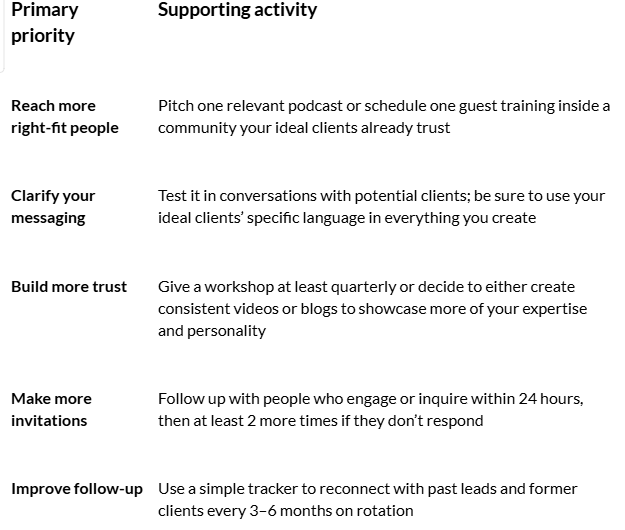
That is enough. Your business does not need 9 priorities wearing name tags that all say “urgent.”
How Do I Know Whether My Priority Is Working?
Give each priority a simple measure connected to progress.
If your priority is visibility, track right-fit people reached, subscribers added, conversations started, or referral introductions received.
If your priority is messaging, track replies, inquiries, and whether potential clients can accurately describe what you help with.
If your priority is invitations or follow-up, track offers made, conversations advanced, consultations booked, and clients signed.
Do not judge every activity only by immediate sales. A podcast interview may add qualified subscribers. A collaboration may start valuable conversations. An email may reveal the objection preventing someone from buying.
Those strategies are effective, yet can still take some time to yield results.
Those results are clues. Use them to decide what to continue, improve, simplify, or stop doing.
What Should I Work on Each Week to Get Coaching Clients?
At a minimum, your week should include focused time to:
Reach or connect with right-fit people (set a goal to hit it every week)
Nurture the people already in your world (especially those on your email list)
Make a clear invitation or advance a sales conversation
Follow up with existing opportunities
Review what those activities produced
Your “reach” time can include connecting with potential collaborators, pitching podcasts, proposing a guest training, or building relationships with people who can introduce you to their audiences. You are not limited to finding every future client one social-media post at a time (in fact, I don’t recommend that).
The amount of time you give each category depends on your first “no.” The goal is not to divide your week evenly. It is to give the biggest priority enough attention to create movement.
If you want help turning that into a realistic weekly plan, grab my free [Your Profitable Weekly Schedule]. It will help you stop treating everything like it is equally urgent and focus on the client- and revenue-generating activities that matter most.
Frequently Asked Questions
What are the most important client-getting activities for a coach?
The most important business activities are those that create revenue and build your email list. More specifically, it’s to help right-fit people find you, understand and trust your work, learn about your offer, and take the next step. These may include strategic visibility, email nurture, direct invitations, sales conversations, referral relationships, and follow-up.
Should a coach focus on content or direct outreach?
It depends on what is currently missing. If too few right-fit people know you exist, strategic outreach and visibility may deserve more attention. If people are finding you but need more trust before buying, content and email nurture may be the better priority. Content and outreach work best when they support the same offer and audience.
But I will say, my default answer is to always prioritize direct outreach.
How many marketing strategies should a coach use at once?
Most messy-middle coaches benefit from choosing 1 primary visibility strategy and 1 supporting nurture strategy long enough to gather useful evidence. Adding several new platforms or strategies at once is not only overwhelming, but it makes it harder to determine what is actually creating clients.
Ready to Know What Deserves Your Attention First?
Recognizing your first “no” is useful. Fixing it while running the rest of your business is where things can get a little more complicated.
InsideThe $5K Month Mentorship, I help messy-middle coaches with a proven offer identify what is creating inconsistent clients and revenue, strengthen the right parts of their business, and build a simpler client-getting strategy they can actually repeat.
We work on the pieces your business needs, including clearer messaging, strategic visibility beyond constant social media, email-list growth, invitations, follow-up, and a weekly plan centered around the work that creates clients and revenue.
No fresh-start fantasy. No rebuilding your business because 1 strategy disappointed you. Just clear priorities, hands-on support, and focused implementation.
Want the mentorship details? DM me “5K MONTHS” on Instagram and I’ll send them your way.